18+ Content Warning

This forum may contain content not suitable for minors.
By clicking "Enter", you confirm that you are
18 years of age or older
and agree to proceed at your own discretion.
Be sure to Read the Terms and Rules before participating.

  • A limited run of Nevada Shooters hats are now available!
    CLICK HERE for details!

GMRS is "Line of Sight"? What does that really mean?

pmn357

Active Member (9mm)
There's a group in Northern Nevada operating a repeater outside of Fernley. I am in East Sparks. I think it's about 15-20 miles from me in a straight line but it's all mountains in between us. I used that SCADA tool and it seems like there is no way a signal could make it. I asked for a radio check (from inside my garage) and received a reply from Fernley as clear as a bell. Pretty neat. But it got me thinking... There must be more to this line of sight business. Does the signal follow the ground to a certain extent? Is it being channeled down I80? There's another repeater in Sun valley about 4.5 miles away with better terrain between us but I have to walk around my yard and be in the right spot to get a very weak signal.
I'm curious to know what you guys think.
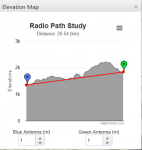
The first picture show an approximation of me to the Fernley repeaterRadio path.PNG.
 
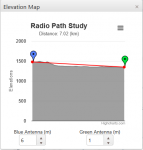
This picture shows me to Sun Valley. I am guessing on the antenna height on the other end. I am on a HT.Capture2.PNG
 
Line of sight with RF depends on the frequency.

VHF for example, is really very much line of sight, just like the beam from a spot light would be.

While it does spread, and it will reflect off some objects and change direction allowing contacts that are not exactly line of sight, and there is what is known as knife edge diffusion, you can't really count on any of those for solid contacts.

Oh, and then during certain parts of the year, you will get atmospheric ducting due to different temperature layers of air, and different moisture contents in those layers.

Right now, due to Atmospheric ducting, I can hit a repeater, and work simplex contacts, in Utah, with two high mountain ranges between us, and 210 miles from my QTH to the repeater, via atmospheric ducting. Summer time, no go, but right now, works most of the time.

Moving on to the UHF band, which is where GMRS falls with it's 462.xxx to 467.xxx frequencies.

UHF is better at bouncing around and finding a way out of whatever is constraining it from a line-of-sight point of view.

It works better in buildings and canyons, etc. than VHF does for that reason. So I am not too surprised you can hit that repeater, the UHF signal is being reflected off lots of things and one of the reflections is finding a path to that repeater.

Ground waves are not a reliable path, especially at VHF and UHF frequencies. The wavelengths are too short, and the ground tends to absorb them instead of propagating them along.

HF signals travel fair distances two ways.

They are reflected off the atmosphere, and depending on the frequency, can travel some very long distances by bouncing between the earth and the atmosphere repeatedly.

Their ground waves also travel further, the earth being more reflective than absorbing with these frequencies.

Often times two stations who are many miles apart but too closes for a frequency to hit them via the skip/bounce of the atmosphere, can communicate because the ground wave manages to reach between the two of them.

VHF and UHF rarely skip /bounce off the atmosphere, they penetrate through it and head out into space, which is why they are used for AMSAT (Amateur radio Satellite communications) and EME (Earth Moon Earth) bounce comms.

 
Line of sight with RF depends on the frequency.

VHF for example, is really very much line of sight, just like the beam from a spot light would be.

While it does spread, and it will reflect off some objects and change direction allowing contacts that are not exactly line of sight, and there is what is known as knife edge diffusion, you can't really count on any of those for solid contacts.

Oh, and then during certain parts of the year, you will get atmospheric ducting due to different temperature layers of air, and different moisture contents in those layers.

Right now, due to Atmospheric ducting, I can hit a repeater, and work simplex contacts, in Utah, with two high mountain ranges between us, and 210 miles from my QTH to the repeater, via atmospheric ducting. Summer time, no go, but right now, works most of the time.

Moving on to the UHF band, which is where GMRS falls with it's 462.xxx to 467.xxx frequencies.

UHF is better at bouncing around and finding a way out of whatever is constraining it from a line-of-sight point of view.

It works better in buildings and canyons, etc. than VHF does for that reason. So I am not too surprised you can hit that repeater, the UHF signal is being reflected off lots of things and one of the reflections is finding a path to that repeater.

Ground waves are not a reliable path, especially at VHF and UHF frequencies. The wavelengths are too short, and the ground tends to absorb them instead of propagating them along.

HF signals travel fair distances two ways.

They are reflected off the atmosphere, and depending on the frequency, can travel some very long distances by bouncing between the earth and the atmosphere repeatedly.

Their ground waves also travel further, the earth being more reflective than absorbing with these frequencies.

Often times two stations who are many miles apart but too closes for a frequency to hit them via the skip/bounce of the atmosphere, can communicate because the ground wave manages to reach between the two of them.

VHF and UHF rarely skip /bounce off the atmosphere, they penetrate through it and head out into space, which is why they are used for AMSAT (Amateur radio Satellite communications) and EME (Earth Moon Earth) bounce comms.

Great explanation, thank you. I knew a little about the atmospheric effect from my CB days. We would park on the bluffs and "shoot the skip", talking to people up and down the coast. Legend had it you could reach Japan if the conditions were right.
I spoke to the owner of the repeater. Very nice gentleman. He held an informal "net" last Saturday to gauge interest and quite a few people chimed in. He must have his antenna in a great spot because people were checking in from a lot further away than I would have thought possible. Even he was impressed.
 
There are two GMRS repeaters on high Potosi down here.
That's on top of a 200 foot tower on top of an 8500 foot mountain. Both are 50 watt repeaters, the max allowed by law, and it can be worked reliability with a 5 watt handheld from all of Pahrump 40 miles to the near edge of town, 60 to the north side.
It can also be worked reliably with a 5 watt from Mesquite NV, and from parts of Hurricane Utah, Mesquite is about 120 miles Hurricane even further. A 50 watt with a high gain vertical GMRS antenna and low loss coax can hit it from 200 miles plus away.
Line of sight plus good atmospheric conditions gets it done. With a high gain yagi, even greater distances are possible.
 
There's a group in Northern Nevada operating a repeater outside of Fernley. I am in East Sparks. I think it's about 15-20 miles from me in a straight line but it's all mountains in between us. I used that SCADA tool and it seems like there is no way a signal could make it. I asked for a radio check (from inside my garage) and received a reply from Fernley as clear as a bell. Pretty neat. But it got me thinking... There must be more to this line of sight business. Does the signal follow the ground to a certain extent? Is it being channeled down I80? There's another repeater in Sun valley about 4.5 miles away with better terrain between us but I have to walk around my yard and be in the right spot to get a very weak signal.
I'm curious to know what you guys think.
The first picture show an approximation of me to the Fernley repeaterView attachment 248370.

Home for me is Vegas but I'll be staying in Reno along S. Meadows next week. I might get out around Fernley and Fallon on some field work during the days as well. Any tips on what I should try to listen to and maybe chime in on?
 
Home for me is Vegas but I'll be staying in Reno along S. Meadows next week. I might get out around Fernley and Fallon on some field work during the days as well. Any tips on what I should try to listen to and maybe chime in on?
Go on Repeaterbook and look for the Fernley "Olinghouse" repeater and send the owner a message requesting access. Super cool guy. There is a core group of people who check in periodically. The owner and a couple of admins tend to monitor during most of the day. Friendly chit-chat is common. A few people use it for family comms driving along I80 between Sparks and Fernley. The range of the repeater is really impressive. I have heard check ins from Dayton, Dog Valley, and nearly to Lovelock. You should be able to hit it everywhere you go up here. I think the same guy runs one in Cold Springs but I can't reach it here in East Sparks.
Then there is the Babbit Peak repeater near Loyalton and one in Sun Valley. These are listed as "open" on the MyGMRS forum. You might hit these in Reno.
 
Decades ago I could reach Hawaii and Australia on the AM/SSB skip late at night. I was in Los Angeles almost high enough to see the Pacific. Still in L.A. Joined the Mesa Crest Repeater Club (GMRS). I can hit the club repeaters as far as 70 miles with a 20 watt mobile.
 
Back
Top