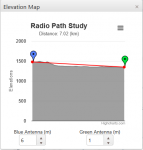
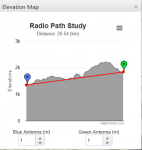
Line of sight with RF depends on the frequency.
VHF for example, is really very much line of sight, just like the beam from a spot light would be.
While it does spread, and it will reflect off some objects and change direction allowing contacts that are not exactly line of sight, and there is what is known as knife edge diffusion, you can't really count on any of those for solid contacts.
Oh, and then during certain parts of the year, you will get atmospheric ducting due to different temperature layers of air, and different moisture contents in those layers.
Right now, due to Atmospheric ducting, I can hit a repeater, and work simplex contacts, in Utah, with two high mountain ranges between us, and 210 miles from my QTH to the repeater, via atmospheric ducting. Summer time, no go, but right now, works most of the time.
Moving on to the UHF band, which is where GMRS falls with it's 462.xxx to 467.xxx frequencies.
UHF is better at bouncing around and finding a way out of whatever is constraining it from a line-of-sight point of view.
It works better in buildings and canyons, etc. than VHF does for that reason. So I am not too surprised you can hit that repeater, the UHF signal is being reflected off lots of things and one of the reflections is finding a path to that repeater.
Ground waves are not a reliable path, especially at VHF and UHF frequencies. The wavelengths are too short, and the ground tends to absorb them instead of propagating them along.
HF signals travel fair distances two ways.
They are reflected off the atmosphere, and depending on the frequency, can travel some very long distances by bouncing between the earth and the atmosphere repeatedly.
Their ground waves also travel further, the earth being more reflective than absorbing with these frequencies.
Often times two stations who are many miles apart but too closes for a frequency to hit them via the skip/bounce of the atmosphere, can communicate because the ground wave manages to reach between the two of them.
VHF and UHF rarely skip /bounce off the atmosphere, they penetrate through it and head out into space, which is why they are used for AMSAT (Amateur radio Satellite communications) and EME (Earth Moon Earth) bounce comms.
















 .
.