















NYECOGunsmith
BANNED FOR ETERNITY!
Staff member
Administrator
Moderator
Nobel Peace Prize Winner!
Forum Supporter
2019 Supporter
2020 Supporter
2021 Supporter
2022 Supporter
2023 Supporter
2024 Supporter
2025 Supporter
2026 Supporter
Trading Post Subscriber
🔥 Invented Fire 🔥
And / or GMRS
this is all from an email I send to folks who ask about getting into radio, either GMRS or Amateur Radio.
Pass this along to anyone interested, lot of info here, but answers most if not all the questions folks have about getting a GMRS (General Mobile Radio Service) license, no test required, just a $35 fee , good for 10 years, covers the entire immediate family.
GMRS is a good starter into amateur radio, fixed channels, but no test required and it gets you your FRN number, which you need to get an Amateur Radio License (Starting with the Technician Class License).
For starters, you need to go to this link for the FCC, and get your FRN (FCC Registration Number) you need it for any FCC license you want to apply for. It is FREE.
Getting an FCC Registration Number (FRN) in the Universal Licensing System (ULS) | Federal Communications Commission
Getting an FCC Registration Number (FRN) in the Universal Licensing Syst...
This article provides information on getting an FCC Registration Number (FRN). You need an FRN if you are “doing...
Then I suggest you apply for a GMRS (General Mobile Radio System) license, no test, $35 to the FCC and it is good for 10 years, renewable every 10 years for $35.
Once licensed with one "Call Sign" (issued by the FCC when they get their $35) the license covers immediate family. GMRS radios, both Walkie Talkies and 50 Watt Mobile radios are inexpensive.
General Mobile Radio Service (GMRS) | Federal Communications Commission (fcc.gov)
General Mobile Radio Service (GMRS)
AboutRule Part47 C.F.R, Part 95 Subpart ERadio Service Code(s)ZA - GMRS
What is GMRS?
Read this:
General Mobile Radio Service - The RadioReference Wiki
I recommend the Radioddity GMR30 5 watt hand held radios for GMRS, very solid, very easy to program, and inexpensive.
Amazon.com: Radioddity GM-30 GMRS Radio Handheld 5W Long Range Two Way Radio for Adults, GMRS Repeater Capable, with NOAA Scanning & Receiving, Display SYNC, for Off Road Overlanding Family Use, 1 Pack : Electronics
Now for the HAM radio stuff....
Now go to QRZ.com and register, it is FREE, and on it you can take FREE online practice tests for all three classes of license, Technician (the entry level license, you have to start with it) General (the next step up, gives you the biggest gain in frequency privileges) and Extra.
Extra gives you a few more frequency privileges over the General, but not that many.
Now you can start studying the attached documents, study the Technician first, if you are passing the QRZ.com online practice tests with a score of 80% or better, you are ready for the real FCC tests, as those, no matter what class of license you are testing for, only require a 74% passing grade. (Nevada Shooters Members, send me a PM with your email address to get the study questions, I can't put the Word Docs here).
There are 35 questions on the Technician Test, drawn from a pool of about 400 questions. Just study the questions I have provided in the attachments, and the correct answer which I have also provided at the end of each question, do this for 30-60 minutes a day, take a practice exam or two at the end of the study session, and within a month, maybe 2, you will be ready to take the Technician exam.
Old time hams call it the "Bored persons license" because it is really easy, with a good memory you can easily pass it, it is mostly rules and regulations (and they are all pretty simple) plus a little bit of electricity (basic 12-volt stuff) and not much else.
By the way, feel free to pass this note and information on to anyone who is interested in getting into radio, and if they are blind, no problem, examiners will read the questions and answers to them on exam day, questions are all multiple choice, A, B, C or D.
Same for folks who have difficulty reading (like folks who are Dyslexic), or folks (we had one of these last exam session, a lady in her 50's) who can pass exams easily if ASKED the questions, but can't pass them if they are required to read the exam and answer the questions by choosing A, B, C, or D. She told us she freezes when presented with a written exam but does fine if someone gives her the exam verbally.
She passed with a perfect score by the way, we just read the questions to her, followed by her answer choices, she marked down the correct letter on the answer sheet herself, although another fellow like this last year, we had to circle the answer he chose for him too.
Here's a link to find an exam near you, you just put in your zip code. It also has info on getting your FRN and such if you need more info than what I gave you above.
Here in Pahrump just send an Email to W7NYE@Yahoo.com and ask when our next exam is, our exams are FREE, but you must register in advance and return the completed registration for to W7NYE@Yahoo.com by 1700 hours (5 PM) on the Wednesday immediately prior to the exam. Exams are held at 1300 hours (1 PM) on the Third Saturday of each month at the NYE County Emergency Operations Center, 1510 Siri Lane, Pahrump, NV 89060, BY RESERVATION ONLY.
An email to the above address of W7NYE@ Yahoo.com will get you the study questions and the exam registration form, and more.
For folks outside of Pahrump, use the link below to find an exam near you.
Find an Amateur Radio License Exam in Your Area (arrl.org)
Find an Amateur Radio License Exam in Your Area
The American Radio Relay League (ARRL) is the national association for amateur radio, connecting hams around the...
There are, as I said, about 400 questions in the Technician question pool, same in the General, and about 600 in the Extra.
Don't let those numbers scare you!
We have to examine you to be sure you know the rules and regulations, etc., in 10 different areas of knowledge, so we have multiple questions for each of those 10 areas.
This is because if you were to fail the exam, and want to take it over, we cannot give you the exact same exam, but we still have to test your knowledge in those 10 areas.
As an example of this, let’s say you are taking a drivers exam, not a ham exam.
We must find out if you know what traffic signals mean.
So, on the exam you first take, and fail, a question you missed was this:
What color light comes on AFTER the yellow traffic light goes out?
Your choices:
A. Magenta
B. Perwinkle
C. Red
D. Mauve
You were nervous and picked B and failed the exam by one or more questions.
By the way, out of 35 questions on each of the Technician and General Exams, you only have to get 26 correct to pass. 37 out of 50 is a passing grade on the Extra exam.
Anyway, you want to take the test over, we still have to know if you understand traffic lights, so on the next test, you might see the question like this:
"The light at the top of the traffic light is ON, what color is it?
A. Red
B. Perwinkle
C. Cyan
D. Mauve
You are not so nervous this time, and choose A, Red, the correct answer.
And these tests, as I said, are all multiple choice. And they follow what is called the
Collegiate test formula, that is, there is only ONE correct answer, one almost correct answer and two total BS answers.
In the question pools I can send you, I went through all the questions, and eliminated all the worthless data, the FCC question numbers, the wrong answers, etc.
So, all you get is the question and the correct answer, easier to study, easier to memorize. And uses up less paper and ink if you want to print them out to study while playing king on the throne..........
Many of the questions will have a word or phrase in the question that is partially or maybe completely repeated in that ONE CORRECT ANSWER. So, look for that kind of thing.
Make note of any questions you are having trouble remembering the answer to, and send them to me in an email, I can supply mnemonic memory tricks for nearly all of them.
And math tricks for the simple math involved.
For example, in the math area, if you are given a frequency of say, 145.520 MHz (that's Mega Hertz) and asked what BAND this is in, just remember the magic number 300.
Divide 300 by the frequency you are given, 300/145.520 = 2.06, if the possible answers are
A. 6 Meter Band
B. 10 Meter Band
C. 20 Meter Band
D. 2 Meter Band
Well, D is your answer. The math here, 300 divided by the frequency will not come out to a perfect number, but the first digit of your answer WILL be the right answer.
And conversely (fancy woid fo da udder way around as Curly Howard use to say!) if you are given a band, and asked what frequency falls in that band, you divide 300 by the band given and the answer will give you the frequency.
What frequency is in the 20 meter band?
300 / 20 = 15.000
Possible answers:
A. 7.289 MHz
B. 3.965 MHz
C. 29.780 MHz
D. 14.320 MHz
Well, D is correct, the result of your math is 15, but that isn't a possible answer offered, so choose the answer CLOSEST to it, which is D, 14.320, which IS in the 20-meter band.
And if you are not familiar with the metric system, I can teach that to you in about 5 minutes, it is very simple.
Sounds like a lot of material t to go through, but really isn't, especially if you break it down into small chunks.
I will also include the simple version of the Ohms Law Pie charts, they are easy to use, in the email I send to you if you ask for the information.
In any question about electricity, you will always be given two out of four things, the four things are Voltage, Resistance and Amperage, and Power (Watts).
Voltage is like water pressure in a pipe, in a water pipe we measure the pressure in pounds per square inch, we measure electrical pressure in Volts, Milli Volts (Milli, means one thousandth of something, or something has been divided into one thousand equal parts) and Micro Volts (Micro means one millionth of something, it has been divided into one million equal parts.)
Volts can also be Mega Volts (Millions of volts, Mega means one million times something) or Kilo Volts (thousands of volts , kilo means one thousand times something).
Volts can also be Kilo Volts, (Kilo is the prefix meaning Thousands of )
Resistance in electricity is the opposition to flow, like putting a kink in a garden hose resists the water flowing, slows it down, reduces its pressure in other words.
It is measured in Ohms, Mega Ohms, Kilo Ohms, Milli Ohms and Micro Ohms, the prefixes all mean the same as they did for voltage.
Amperage, measured in AMPERES, AMPs for short, is like the volume of water in a pipe, with water we would call it gallons per minute, with electricity, it is Amps.
Same prefixes apply here, Mega, Kilo, Milli, Micro.
To use the Ohms Law Pie chart to solve a question you will be given two of those four things, Volts, (called E for Electro motive force on the pie chart) R (for resistance in Ohms) and I , for current in Amps, don't remember why Amps uses the symbol I on the chart, Latin I think, or P , for Power, expressed in watts. The question will give you two of the four, and ask you to find a third, and it will name the third.
For example, if you are given 10 Volts (10 E) and 2 Amps (2I) and asked what is the resistance in the circuit, if you look at the chart that has E on top of a line that divides a circle in half, and below it are R and I, you put your finger on the missing one, in this case the R, and since E is above I, you would divided 10 Volts by 2 amps to get 5 OHMS.
In other words, that circle shows you what math to do.
If one given value is above the diameter line, and the other below it, you divide the value above the line by the one below it, no matter which one it is, the I or the R.
The answer will be the other one below the line.
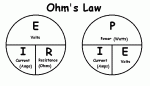
IF the two given values are both below the line, side by side in other words, you multiply them to get the answer which is the E above the line.
Example:
Give 3 Amps and 25 Ohms, how much voltage E is present in the circuit?
The I and R (amps and ohms) are side by side, so multiply them and you get 75 Volts, the answer.
You can use a calculator in the exam, but it cannot be the one in your cell phone. A simple $1 Wal mart 4 function (addition, subtraction, multiplication and division) type is all you need.
Anyway, any questions you have, holler, if I can't answer them, I will find someone for you who can.
Sorry to be so long winded, it stems from life experiences. I have seen men die from a lack of sufficient information on a subject, but I have yet to see anyone die from having too much information on a subject.
Here are links on where to buy radios, both HAM and GMRS.
Ham Radio Outlet (called HRO) HRO.com
Gigaparts.com.
DXEngineering
I recommend sticking with the YAESU brand HAM radios, they are usually 10% (or more) LESS expensive than other brands, but 100% reliable, made in CA, the easiest to use and understand, they are what we used in the government, those and Motorola, but you have to be a billionaire to afford the Motorola stuff! Icom, Alinco, Kenwood, all make great radios, however they are all generally much more expensive than the equivalent Yaesu radio, don't have the Yaesu 3 YEAR warranty, nor the close by factory service, and most of them are not Mil Spec, the Yaesu's are. And the Yaesu is the easiest to program manually, learn to program one Yaesu, you just learned pretty much all of them, hand held, mobile, desktop, made since 1972, as they kept to the same alphabetic menu no matter what the model or type.
That's about it for now, you know where to find me if you have questions.
73's
V/r
Regards,
Nyecogunsmith
KE7KHE / WRPI429
this is all from an email I send to folks who ask about getting into radio, either GMRS or Amateur Radio.
Pass this along to anyone interested, lot of info here, but answers most if not all the questions folks have about getting a GMRS (General Mobile Radio Service) license, no test required, just a $35 fee , good for 10 years, covers the entire immediate family.
GMRS is a good starter into amateur radio, fixed channels, but no test required and it gets you your FRN number, which you need to get an Amateur Radio License (Starting with the Technician Class License).
For starters, you need to go to this link for the FCC, and get your FRN (FCC Registration Number) you need it for any FCC license you want to apply for. It is FREE.
Getting an FCC Registration Number (FRN) in the Universal Licensing System (ULS) | Federal Communications Commission
Getting an FCC Registration Number (FRN) in the Universal Licensing Syst...
This article provides information on getting an FCC Registration Number (FRN). You need an FRN if you are “doing...
Then I suggest you apply for a GMRS (General Mobile Radio System) license, no test, $35 to the FCC and it is good for 10 years, renewable every 10 years for $35.
Once licensed with one "Call Sign" (issued by the FCC when they get their $35) the license covers immediate family. GMRS radios, both Walkie Talkies and 50 Watt Mobile radios are inexpensive.
General Mobile Radio Service (GMRS) | Federal Communications Commission (fcc.gov)
General Mobile Radio Service (GMRS)
AboutRule Part47 C.F.R, Part 95 Subpart ERadio Service Code(s)ZA - GMRS
What is GMRS?
Read this:
General Mobile Radio Service - The RadioReference Wiki
I recommend the Radioddity GMR30 5 watt hand held radios for GMRS, very solid, very easy to program, and inexpensive.
Amazon.com: Radioddity GM-30 GMRS Radio Handheld 5W Long Range Two Way Radio for Adults, GMRS Repeater Capable, with NOAA Scanning & Receiving, Display SYNC, for Off Road Overlanding Family Use, 1 Pack : Electronics
Now for the HAM radio stuff....
Now go to QRZ.com and register, it is FREE, and on it you can take FREE online practice tests for all three classes of license, Technician (the entry level license, you have to start with it) General (the next step up, gives you the biggest gain in frequency privileges) and Extra.
Extra gives you a few more frequency privileges over the General, but not that many.
Now you can start studying the attached documents, study the Technician first, if you are passing the QRZ.com online practice tests with a score of 80% or better, you are ready for the real FCC tests, as those, no matter what class of license you are testing for, only require a 74% passing grade. (Nevada Shooters Members, send me a PM with your email address to get the study questions, I can't put the Word Docs here).
There are 35 questions on the Technician Test, drawn from a pool of about 400 questions. Just study the questions I have provided in the attachments, and the correct answer which I have also provided at the end of each question, do this for 30-60 minutes a day, take a practice exam or two at the end of the study session, and within a month, maybe 2, you will be ready to take the Technician exam.
Old time hams call it the "Bored persons license" because it is really easy, with a good memory you can easily pass it, it is mostly rules and regulations (and they are all pretty simple) plus a little bit of electricity (basic 12-volt stuff) and not much else.
By the way, feel free to pass this note and information on to anyone who is interested in getting into radio, and if they are blind, no problem, examiners will read the questions and answers to them on exam day, questions are all multiple choice, A, B, C or D.
Same for folks who have difficulty reading (like folks who are Dyslexic), or folks (we had one of these last exam session, a lady in her 50's) who can pass exams easily if ASKED the questions, but can't pass them if they are required to read the exam and answer the questions by choosing A, B, C, or D. She told us she freezes when presented with a written exam but does fine if someone gives her the exam verbally.
She passed with a perfect score by the way, we just read the questions to her, followed by her answer choices, she marked down the correct letter on the answer sheet herself, although another fellow like this last year, we had to circle the answer he chose for him too.
Here's a link to find an exam near you, you just put in your zip code. It also has info on getting your FRN and such if you need more info than what I gave you above.
Here in Pahrump just send an Email to W7NYE@Yahoo.com and ask when our next exam is, our exams are FREE, but you must register in advance and return the completed registration for to W7NYE@Yahoo.com by 1700 hours (5 PM) on the Wednesday immediately prior to the exam. Exams are held at 1300 hours (1 PM) on the Third Saturday of each month at the NYE County Emergency Operations Center, 1510 Siri Lane, Pahrump, NV 89060, BY RESERVATION ONLY.
An email to the above address of W7NYE@ Yahoo.com will get you the study questions and the exam registration form, and more.
For folks outside of Pahrump, use the link below to find an exam near you.
Find an Amateur Radio License Exam in Your Area (arrl.org)
Find an Amateur Radio License Exam in Your Area
The American Radio Relay League (ARRL) is the national association for amateur radio, connecting hams around the...
There are, as I said, about 400 questions in the Technician question pool, same in the General, and about 600 in the Extra.
Don't let those numbers scare you!
We have to examine you to be sure you know the rules and regulations, etc., in 10 different areas of knowledge, so we have multiple questions for each of those 10 areas.
This is because if you were to fail the exam, and want to take it over, we cannot give you the exact same exam, but we still have to test your knowledge in those 10 areas.
As an example of this, let’s say you are taking a drivers exam, not a ham exam.
We must find out if you know what traffic signals mean.
So, on the exam you first take, and fail, a question you missed was this:
What color light comes on AFTER the yellow traffic light goes out?
Your choices:
A. Magenta
B. Perwinkle
C. Red
D. Mauve
You were nervous and picked B and failed the exam by one or more questions.
By the way, out of 35 questions on each of the Technician and General Exams, you only have to get 26 correct to pass. 37 out of 50 is a passing grade on the Extra exam.
Anyway, you want to take the test over, we still have to know if you understand traffic lights, so on the next test, you might see the question like this:
"The light at the top of the traffic light is ON, what color is it?
A. Red
B. Perwinkle
C. Cyan
D. Mauve
You are not so nervous this time, and choose A, Red, the correct answer.
And these tests, as I said, are all multiple choice. And they follow what is called the
Collegiate test formula, that is, there is only ONE correct answer, one almost correct answer and two total BS answers.
In the question pools I can send you, I went through all the questions, and eliminated all the worthless data, the FCC question numbers, the wrong answers, etc.
So, all you get is the question and the correct answer, easier to study, easier to memorize. And uses up less paper and ink if you want to print them out to study while playing king on the throne..........
Many of the questions will have a word or phrase in the question that is partially or maybe completely repeated in that ONE CORRECT ANSWER. So, look for that kind of thing.
Make note of any questions you are having trouble remembering the answer to, and send them to me in an email, I can supply mnemonic memory tricks for nearly all of them.
And math tricks for the simple math involved.
For example, in the math area, if you are given a frequency of say, 145.520 MHz (that's Mega Hertz) and asked what BAND this is in, just remember the magic number 300.
Divide 300 by the frequency you are given, 300/145.520 = 2.06, if the possible answers are
A. 6 Meter Band
B. 10 Meter Band
C. 20 Meter Band
D. 2 Meter Band
Well, D is your answer. The math here, 300 divided by the frequency will not come out to a perfect number, but the first digit of your answer WILL be the right answer.
And conversely (fancy woid fo da udder way around as Curly Howard use to say!) if you are given a band, and asked what frequency falls in that band, you divide 300 by the band given and the answer will give you the frequency.
What frequency is in the 20 meter band?
300 / 20 = 15.000
Possible answers:
A. 7.289 MHz
B. 3.965 MHz
C. 29.780 MHz
D. 14.320 MHz
Well, D is correct, the result of your math is 15, but that isn't a possible answer offered, so choose the answer CLOSEST to it, which is D, 14.320, which IS in the 20-meter band.
And if you are not familiar with the metric system, I can teach that to you in about 5 minutes, it is very simple.
Sounds like a lot of material t to go through, but really isn't, especially if you break it down into small chunks.
I will also include the simple version of the Ohms Law Pie charts, they are easy to use, in the email I send to you if you ask for the information.
In any question about electricity, you will always be given two out of four things, the four things are Voltage, Resistance and Amperage, and Power (Watts).
Voltage is like water pressure in a pipe, in a water pipe we measure the pressure in pounds per square inch, we measure electrical pressure in Volts, Milli Volts (Milli, means one thousandth of something, or something has been divided into one thousand equal parts) and Micro Volts (Micro means one millionth of something, it has been divided into one million equal parts.)
Volts can also be Mega Volts (Millions of volts, Mega means one million times something) or Kilo Volts (thousands of volts , kilo means one thousand times something).
Volts can also be Kilo Volts, (Kilo is the prefix meaning Thousands of )
Resistance in electricity is the opposition to flow, like putting a kink in a garden hose resists the water flowing, slows it down, reduces its pressure in other words.
It is measured in Ohms, Mega Ohms, Kilo Ohms, Milli Ohms and Micro Ohms, the prefixes all mean the same as they did for voltage.
Amperage, measured in AMPERES, AMPs for short, is like the volume of water in a pipe, with water we would call it gallons per minute, with electricity, it is Amps.
Same prefixes apply here, Mega, Kilo, Milli, Micro.
To use the Ohms Law Pie chart to solve a question you will be given two of those four things, Volts, (called E for Electro motive force on the pie chart) R (for resistance in Ohms) and I , for current in Amps, don't remember why Amps uses the symbol I on the chart, Latin I think, or P , for Power, expressed in watts. The question will give you two of the four, and ask you to find a third, and it will name the third.
For example, if you are given 10 Volts (10 E) and 2 Amps (2I) and asked what is the resistance in the circuit, if you look at the chart that has E on top of a line that divides a circle in half, and below it are R and I, you put your finger on the missing one, in this case the R, and since E is above I, you would divided 10 Volts by 2 amps to get 5 OHMS.
In other words, that circle shows you what math to do.
If one given value is above the diameter line, and the other below it, you divide the value above the line by the one below it, no matter which one it is, the I or the R.
The answer will be the other one below the line.
IF the two given values are both below the line, side by side in other words, you multiply them to get the answer which is the E above the line.
Example:
Give 3 Amps and 25 Ohms, how much voltage E is present in the circuit?
The I and R (amps and ohms) are side by side, so multiply them and you get 75 Volts, the answer.
You can use a calculator in the exam, but it cannot be the one in your cell phone. A simple $1 Wal mart 4 function (addition, subtraction, multiplication and division) type is all you need.
Anyway, any questions you have, holler, if I can't answer them, I will find someone for you who can.
Sorry to be so long winded, it stems from life experiences. I have seen men die from a lack of sufficient information on a subject, but I have yet to see anyone die from having too much information on a subject.
Here are links on where to buy radios, both HAM and GMRS.
Ham Radio Outlet (called HRO) HRO.com
Gigaparts.com.
DXEngineering
I recommend sticking with the YAESU brand HAM radios, they are usually 10% (or more) LESS expensive than other brands, but 100% reliable, made in CA, the easiest to use and understand, they are what we used in the government, those and Motorola, but you have to be a billionaire to afford the Motorola stuff! Icom, Alinco, Kenwood, all make great radios, however they are all generally much more expensive than the equivalent Yaesu radio, don't have the Yaesu 3 YEAR warranty, nor the close by factory service, and most of them are not Mil Spec, the Yaesu's are. And the Yaesu is the easiest to program manually, learn to program one Yaesu, you just learned pretty much all of them, hand held, mobile, desktop, made since 1972, as they kept to the same alphabetic menu no matter what the model or type.
That's about it for now, you know where to find me if you have questions.
73's
V/r
Regards,
Nyecogunsmith
KE7KHE / WRPI429
Last edited: