18+ Content Warning

This forum may contain content not suitable for minors.
By clicking "Enter", you confirm that you are
18 years of age or older
and agree to proceed at your own discretion.
Be sure to Read the Terms and Rules before participating.

  • A limited run of Nevada Shooters hats are now available!
    CLICK HERE for details!

2017 Toyota Tecoma TRD PRO


Ironworker

Member (9mm)
Forum Supporter
2023 Supporter
2024 Supporter
Trading Post Subscriber
Is there something wrong with 0-20WT oil ? Some manufacturers use it to meet gas mileage claims. My Toyota has 171,000 miles and runs like a spinning top. With this high mileage would I want a heavier WT oil?
 
I always use heavier especially in Vegas. 0-20 is for them to meet their emissions bull(crap). It’s not good for engines.
Look at the Chevy 6.2 in the Silverados. They moved them to 40 as they were having issues. All the high performance cars use 40.
 
I use 20-50 in my older truck .... Change every 5000 miles. Never had a problem
 
If I switch to a heavier oil,will I need a different oil filter?
 
My ‘24 Z06 uses 5W-50 synthetic if that helps. It red lines @8600 rpm.
 
A Toyota Mechanic said "do not switch to a heavier oil. My engine is specifically for that weight of oil"
 
I use 5-20 or 5-30 in everything. 5-20 during winter and 5-30 in the summer.
I used Valvoline "Restore & Protect" full synthetic. You can watch YouTube reviews. Good stuff. It's really good at cleaning out carbon and varnish deposits with repeated use. New engines use low-tension oil rings and they can get gummed up quick if you use cheap oil or change it at stupid factory recommended intervals. My son has a 2025 Volkswagen Jetta with a 1.5 turbo. I told him to put only premium fuel in it.
I called Volkswagen and said the recommended oil change interval is 10,000 miles 😲😠. They also use 0-20 weight.

There's no way in hell I'm leaving that watery oil in that new engine for 10,000 miles.
I changed it at 2,000 miles (1st oil change). I'll change it again 4,000 miles later.
I used 5-30 Valvoline in my son's Jetta.
The 0-10 and 0-15, 0-20 oils and ridiculous factory change intervals are destroying engines.
Just look at GM recalling almost all 6.2 engines for urgent oil changes. The 6.2 is eating itself alive. Some 6.2 V8's are blowing up before the first factory oil change is even due.
Advice? Ignore factory recommended oil change intervals. Change your oil every 4,000 or 5,000 miles. Use high quality 5-20 or 5-30 synthetic oil. When it's really hot outside use 10-20 or 10-30 synthetic oil.
It's cheaper than a new engine.
 
Napa store brand oil is (or was the last time I checked) made by Valvoline. It typically goes on sale every 3 weeks and makes oil changes even more affordable. I used to run I exclusively before I went to a diesel.
 
My Toyota Tecoma TRD PRO 2017 has 179,000 miles,the idiot lights goes on every 3,000 miles, I use Valvoline Full synthetic 0-20 oil. My Truck still to this day runs like a spinning top
 
I believe the problem with 0-15 and 0-20 oil is shear strength, especially on a really hot day, under a hard load. Like towing a camper or loaded trailer going up a hill in 100° weather. If you baby the engine it's entire life it probably won't make a big difference.
Right now GM's "bandaid fix" to their exploding 6.2 liter engines is changing the oil viscosity to a heavier weight.

If I had a new Corvette I surely wouldn't want 0-anything weight in that engine.
 
Is there something wrong with 0-20WT oil ? Some manufacturers use it to meet gas mileage claims. My Toyota has 171,000 miles and runs like a spinning top. With this high mileage would I want a heavier WT oil?
How often do you change your oil? Do you follow the recommended factory intervals or do you use another method? Every 3,000 correct?
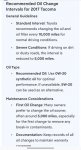
The big question is when your engine is at normal running temperature, what is your oil pressure like? Do you have a guage or a light? If you have noticed a reduction in oil pressure over the years a heavier oil would be an excellent idea.

1000021933.jpg
 
Last edited:
It’s not just about miles between oil changes anymore. I know that in May ‘26 the Z06 will have Zero oil life left on it. I had the service done this past May and when the year is past it will be time to change it out. It only has 1200 miles on the odometer.
Not that it’s a bad thing for the car.

The Highlander is 10K miles or 1 year but we change oil and rotate tires at 5k. 10K seems a bit long on the tooth so we cut that in half.

We did the Telluride service at 4200 miles since we‘re leaving today for Boise to visit the kiddos for Thanksgiving. Recommended oil changes for that car is every 5k.
 
How often do you change your oil? Do you follow the recommended factory intervals or do you use another method? Every 3,000 correct?
The big question is when your engine is at normal running temperature, what is your oil pressure like? Do you have a guage or a light? If you have noticed a reduction in oil pressure over the years a heavier oil would be an excellent idea.

View attachment 271558
For us, the dealerships in our small town keep all records for service. I keep the receipts in the glove boxes, but they usually email me prompting an appointment.
We don’t drive much anymore, usually just groceries and back and forth to the range.

Oh, and we split the drives to restaurants with friends 2-3 times weekly. It’s nice because one of us will be the DD until we come back to our house for some cocktails and everyone can walk home from here weather permitting.
 
Is there something wrong with 0-20WT oil ? Some manufacturers use it to meet gas mileage claims. My Toyota has 171,000 miles and runs like a spinning top. With this high mileage would I want a heavier WT oil?
If it isn't broke, I'd say do not fix it. I picked up a new Mazda this year that uses 0-20. My solution is to perform oil and filter changes premature to what the manufacturer recommends, without using cheap oil and filters. Clean oil will go a long way in these Jap designed units.
 
The whole reason for these "0" weight oils is for less friction, better gas mileage figures. Not so much for durability.
The EPA and NHTSA are the government agencies that regulate and determine corporate fuel economy standards, known as CAFE standards.
For model year 2026 vehicles must achieve an average of 55 mpg, which forces manufacturers to squeeze every mile they can out of a gallon of fuel.
This is why new cars have the annoying "engine stop-start" bullsh*t every time you come to a stop light. The engine shuts off. As soon as you take your foot of the brake pedal the engine restarts. On most vehicles you can disable this feature, but by default, you have to disable it every time you get in the vehicle. Very annoying.
My 2019 Chevy has this feature. I have to disable it every time I start the engine.
Now here's the interesting part. CAFE standard are more strict every year going forward.
I don't care that much about fuel mileage. I'm more concerned about engine reliability and durability.
 
Do you have a guage or a light?

Does anything (non-HD) come with an actual gauge anymore? That would be nice.

My 2019 Chevy has this feature. I have to disable it every time I start the engine.

Check out devices such as 'Auto Stop Eliminator' / 'Idlestopper'. They can be plugged in, in-line and will remember the last state it was in. I use a version for my SUV to keep this permanent off. Varies by make and model so one may or may not be available for your application.
 
Last edited:
Back
Top