johnthomas
Henderson
Forum Supporter
2020 Supporter
2021 Supporter
2022 Supporter
2023 Supporter
2024 Supporter
I hate most drivers, cars are fine.
This forum may contain content not suitable for minors.
By clicking "Enter", you confirm that you are
18 years of age or older
and agree to proceed at your own discretion.
Be sure to Read the Terms and Rules before participating.














Hey I didnt get the memo for a road trip!


As a general rule, at moderate slow speeds, you can gain 10% of the energy to go back up the same hill at the same speed. At very slow speeds, it's even a bit better. So ~90% loss, right? That will never work!or did I miss something

I don't feel bad at all. When I first read the article, I had the exact same thoughts at first, "Something ain't right here, there ain't no free lunch or perpetual motion"....Don don't feel bad "nyecounty" doesn't believe
supercapacitor jump starters really work.
I guess you're already on your way, but I was going to ask which way you're going to SF and if you would like to stay overnight at one of my houses, either here in Reno or Auburn. I have a total of 8 bedrooms I don't use! I don't even use the master bedroom at my Auburn house.Damn, I have to drive to San Francisco tomorrow to look at a gas guzzling Harley Trike!
Not much of a drawback in a country where the average driver drives less than 40 miles per day and only charges at home and/or work.Biggest drawback to electric cars right now besides price, are the number of charging stations and the time it takes to charge the car to full capacity.
Now that I have more time (now in Auburn, no longer rushing to leave Reno) I will go over some other points.Ok, if it starts up that 13% grade with a 100% charge in the battery, and it gets to the top with a 80% charge remaining,

 . ????
Don don't feel bad some people doesn't believe supercapacitor jump starters really work.
I have used one it worked. Lights on the car would turn on but there wasn't enough power to start the engine. But I left a supercapacitor charger on the battery for 15 minutes and it supplied enough power to turn over the engine briefly and it started. Don't know if there was enough power left in the battery try a second time, if it had not started the first try. You can also hook up the capacitor charger to a running car charge up the capacitors and then transfer that back over to the car needing a jump.
There was a time when lead acid batteries were the only thing around. People could never imagine a small carbon-based battery being put in a portable torch.
Then came alkaline batteries and nickel and now lithium-ion and who knows what's around the corner next.
Who knows in the next 10 years an electric car may be able to accept a 300 mile charge in 10 minutes and charging stations may be as plentiful as gas stations.
Biggest drawback to electric cars right now besides price, are the number of charging stations and the time it takes to charge the car to full capacity.
How about 20 minutes as you take a break?But if I need a car to drive up the Salt Lake City or Reno I don't want to have to rent a car or own one that's going to take 11 hours to get up there because it's going to take hours to charge.
I guess you're already on your way, but I was going to ask which way you're going to SF and if you would like to stay overnight at one of my houses, either here in Reno or Auburn. I have a total of 8 bedrooms I don't use! I don't even use the master bedroom at my Auburn house.
Anyway, I am now in Reno, but I will be taking a motorcycle to my Auburn place in a few minutes. Are you on-line as you travel as I always am?
Auburn is ~120 miles from SF. Have fun in that traffic near SF! I try my best to stay away from that area! And I used to live there!
-Don-


Like this ?Someone around here in Vegas is driving around with a trike that has a downsized 57 Chevy rear end on it. I don't know if I like it or not but it sure is unusual and neat. Best of both worlds maybe or worst
If you have a laptop, you can tether your cell. See if you cell has the tether function. I think all the Smartphones do.Thanks for the offer, but we were already on the road. And I don't use (don't know how) my cell phone for internet, I plod along like it's 1995!
Sunday can be one of the worse days in some areas going west to SF. You can see why I am glad to be out of the area I was born and raised in. But the LA area is even worse. The last time I drove to LA, it took a full day to drive out of it.Correct, traffic sucks, even on a Sunday! 15 minute standstill south of Gilroy, FOR NO REASON! And another 45 minutes lost after San Jose!
I would have taken 58 to 99 and and 99 to 5 through Wasco on 46, and 152 to Hwy 101, 280 or 380 to SF. Still won't be all that good in some parts. You don't want to be on 101 when you get very close to SF.We went south to Baker, then took Hwy 58 to the 101. Didn't know how much time would be lost in the twisty roads to the north. In retrospect, it might have been faster, or at least mellower, to take the northern routes! By the time we hit San Fran I wanted to murder someone, but there were too many targets!
I don't even own one!I'd ask to borrow a bike trailer, but have no idea when I could get it back to you.
Too much to even think about remembering.Now that I have more time (now in Auburn, no longer rushing to leave Reno) I will go over some other points.
In most cases, it is best to not start at 100% SOC (State of Charge). The charge rate MUST slow down a lot near the top. Same is true at the very bottom of the SOC. Charge to 100% when it is needed for extra range and occasionally at other times for the best cell balancing.
But at least the 100% is at the bottom of the hill, but is it really 100 SOC? Or is that just an indication of where they want it?
Charging more times is faster than charging less times!
Less time will be spent recharging when at 35 % SOC and stopping the charge at 80% SOC. IOW, charge twice for ten minutes each instead of one time for more than 35 minutes to get the exact same miles added at the same type of charger.
The same happens with regen.
Regen power is VERY high in the midrange of the battery. Very low on each end. 80% SOC is too much for the top of the hill. They should try for 50% SOC on top of the hill and less than 80% SOC at the bottom.
But perhaps it indicates 100% SOC at that true 60%. That is an unknown, as we didn't design it. No doubt a lot of this stuff was thought about in the design.
But starting at real 100% SOC is a big waste of energy. You never want to be up there, except then you expect to discharge to below 10% at the end of the trip as you need the full possible range. In fact, regen turns completely off or to almost nothing in EVs when getting close to 100% SOC. The exception is for occasional cell balancing, once in a great while let it charge to full. And then use some of it so it doesn't stay at full too long.
Charging near full very inefficient. If the BMS (Battery Management System which is built into EV batteries) would let it really charge at the full rate near 100% SOC , the battery could catch fire if not explode.
My Tesla gives me a warning when charged to full as soon as I drive "Warning: REGEN temporality suspended".
My Energica says "Warning, no regen!" Get down to 95% and you get SOME regen. Full regen a few miles later, perhaps at 90%.
No regen means the car / bike will coast a lot better, and good coasting is NOT what EV owners expect. It means I will have to use the brake where I normally would not even need to touch it.
Look at the specs of charge times on most EVs. They rate them (let me check a manual here for a real number): "DC Fast Charge, 0-85% SOC in 20 minutes". That is from My Energica motorcycle manual. Now you know why they are rated in that way. They don't want to mention that very slow charge rate above 85% SOC. And it has started to slow down a little at perhaps 75% SOC. Then it's a progressive slowdown from there.
And to add a little more confusion to this issue, no EV battery will be 100% fully charged at 100 SOC. Nor will it be fully discharged at BELOW Zero SOC (there is a reserve) when the EV will no longer run (other than military Evs). EVs made for the military have a switch to use that very last 10 or 15% percent of the real charge (well below the 0 SOC indicated) that will most likely permanently ruin the very expensive battery but could save a life.
There are two specs for KWH on a battery. And some cheating goes on because of this. Zero Motorcycle cheats. Their 14.4 KWH battery can never be charged to that 14.4KWH. The BMS will not allow that very expensive battery to be ruined! It will charge to about 11.6 KWHs according to some battery techs in the electric motorcycle forum.
Energica does not cheat. Their spec reads like this "21.5 kWH max / 18.9 KWH nominal." It will stop being charged when at 18.9 KWH and all of that 18.9 KWH can be used.
73, -Don- AA6GA Auburn, CA
I didn't get a good look, it was red, yea it sure could have been a bosshoss. I didn't get a good look at the engine so I really can't say.
If you have a laptop, you can tether your cell. See if you cell has the tether function. I think all the Smartphones do.
Sunday can be one of the worse days in some areas going west to SF. You can see why I am glad to be out of the area I was born and raised in. But the LA area is even worse. The last time I drove to LA, it took a full day to drive out of it.
I would have taken 58 to 99 and and 99 to 5 through Wasco on 46, and 152 to Hwy 101, 280 or 380 to SF. Still won't be all that good in some parts. You don't want to be on 101 when you get very close to SF.
I don't even own one!
So are you buying that HD trike?
-Don- Auburn, CA
I assume that means you are going back to SF again to pick up the bike. If an over night stop will be helpful in Auburn or Reno (or both) let me know. Or if you need anything on the way there are back, etc.Getting the truck AC serviced, then it's off to the races!
I assume that means you are going back to SF again to pick up the bike. If an over night stop will be helpful in Auburn or Reno (or both) let me know. Or if you need anything on the way there are back, etc.
What part of SF is the trike in? BTW, what engine is in it and what year?
-Don- Auburn, CA
I used to live in SSF, just north of the airport. Zip 94080. The very base of San Bruno Mountain (the hill you see as you drive north).The bike is in So. San Fran, just past the airport.
We're probably taking the 5 up and cross over to the 101 at Los Banos. It's the shortest, (as if there were any), way. Won't be anywhere near Auburn.
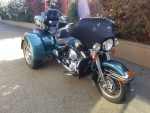
It's a 2002 Ultra Classic w/ 43k miles, but the engine was rebuilt at 40k. 95 inch, big bore kit, Lehman kit w/ independent suspension. Baker 6 speed w/ reverse, etc. All receipts since new.
Not a scratch. Washed and waxed every month. Looks brand new.